
PRP Hair Treatment in Surat
PRP Sessions for Hair Loss in Surat
PRP sessions for hair loss in Surat are given as a course, not as a single treatment. A common plan is three to four sessions about a month apart, followed by maintenance every four to six months if there is a response. PRP is a supportive treatment used alongside medical care, and the response differs from person to person.
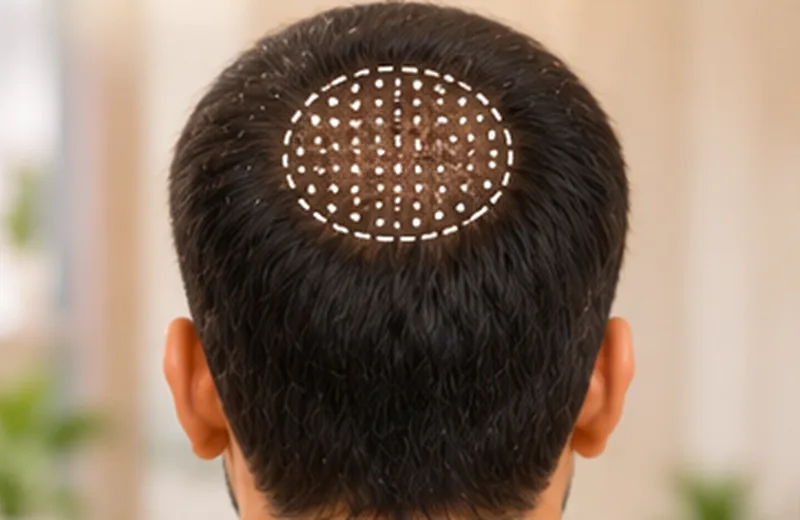
What is a PRP course for hair loss?
PRP means platelet-rich plasma. A small sample of your blood is spun to concentrate the platelets, and the concentrate is injected into the thinning scalp. Platelets carry growth factors that may support weakened follicles.
Because hair grows slowly, one session cannot be judged on its own. A course lets the scalp receive repeated doses over one hair cycle.
Who is a PRP course suitable for?
It is considered for early to moderate pattern hair loss in men and women, for some types of shedding, and as support after a hair transplant. Follicles must still be present; PRP does not grow hair on a smooth, bare scalp.
It may not suit people with low platelet counts, blood disorders, active scalp infection or those on blood thinners. These are checked first.
What happens at each session?
- About 10 to 20 ml of blood is drawn from the arm.
- The sample is spun in a centrifuge to separate the platelet-rich layer.
- The scalp is cleaned and numbed with cream or a nerve block.
- The concentrate is injected across the thinning area with a fine needle.
The visit takes 45 to 60 minutes, and you can return to routine activity the same day.
How is the response judged?
Standard photographs and, where available, trichoscopy are taken before the first session and repeated at about three and six months. Reduced shedding is usually the first sign, followed by thicker hair shafts. If there is no change after a full course, the plan is reviewed and PRP is not continued without reason.
What are the risks and limits?
Soreness, mild swelling and pinpoint bleeding for a day are common. Headache, infection and temporary shedding are uncommon. Because your own blood is used, allergic reaction is unlikely.
The evidence for PRP is promising but varies between studies, and results are not the same for everyone. It supports, and does not replace, medical hair-loss treatment.
What affects the cost in Surat?
The number of sessions in the course, the preparation system used and any maintenance sessions decide the total. Ask for the course cost and the maintenance cost separately.
The main PRP hair treatment page explains the treatment in full, and GFC hair treatment describes a related option.
Independent patient information: NHS: hair loss and American Academy of Dermatology: hair loss.
Common questions
PRP Sessions for Hair Loss in Surat, answered.
Short, honest answers. Your own case is discussed at consultation. All questions.
How many PRP sessions are needed for hair?
A common starting course is three to four sessions about a month apart. Maintenance every four to six months is considered if the first course shows a response. The exact plan depends on the cause of your hair loss and how you respond, and it is reviewed with you at each visit.
When will I see a change after PRP?
Less shedding is usually the first sign and may be noticed after the second or third session. Changes in thickness take longer and are judged with standard photographs at about three and six months. If there is no change after a full course, the plan is reviewed.
Can I wash my hair after a PRP session?
Hair washing is usually allowed the next day with a mild shampoo. Avoid colouring, straightening and other harsh chemical treatments for a few days, and skip heavy exercise and saunas for a day or two. Mild soreness of the scalp for a day is normal and settles on its own.
Is PRP enough on its own for pattern hair loss?
Usually not. Pattern hair loss is driven by hormones and genes, and PRP does not change that cause. It is used alongside medical treatment that does address it. On its own it is not expected to control pattern hair loss, although it may support the hair that is present.
Do I need PRP for life?
No one needs it for life. If it helps, maintenance sessions keep the effect going, and if it does not help after a full course, it is stopped. The decision to continue is reviewed with you at follow-up visits, based on how your hair has responded so far.
Consultation with Dr. Ashutosh Shah at the Vesu clinic, by appointment. No forms, no waiting on hold.