
Patient guide
Hair Transplant FAQs
The questions patients in Surat ask most, answered plainly. Your own case is discussed at consultation.
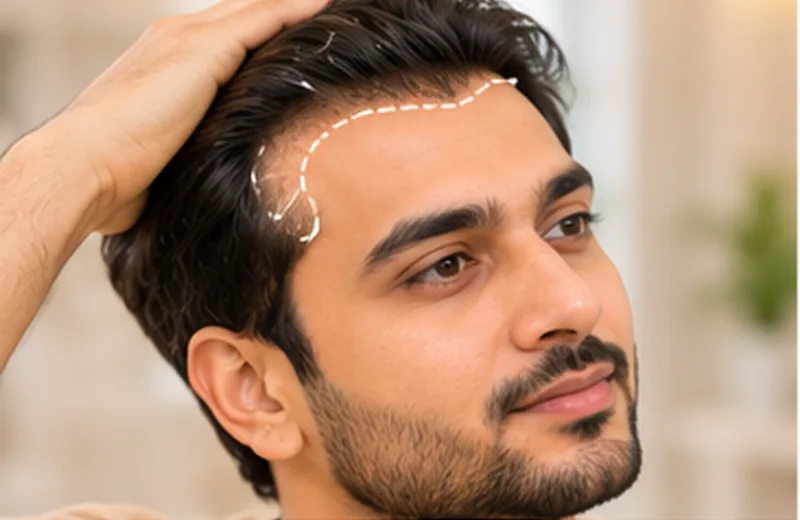
Am I suitable for a hair transplant?
If your hair loss is stable, your donor area is adequate and your expectations are realistic, probably yes. It is decided at consultation after examining the scalp and donor area, never from a photo alone. Your age, general health and medicines are also taken into account.
At what age can a hair transplant be done?
Usually from the mid-twenties, once the pattern of hair loss is clearer. In younger patients the loss is still developing, so medical treatment to stabilise it is advised first, followed by a conservative plan later. Operating too early can leave an unnatural pattern as more hair is lost.
Can women have a hair transplant?
Yes, in selected cases: a stable pattern with a good donor area, hairline lowering, temple recession, traction loss or scars. Diffuse thinning usually means medical treatment instead. The cause of the hair loss is checked first, because that decides whether surgery or medicines will suit you.
Can diabetes or thyroid disease affect surgery?
They can, if they are not controlled. Poorly controlled diabetes slows healing and raises the risk of infection, and thyroid disease can itself cause hair loss. Both are reviewed at consultation, with recent test results. Once they are well controlled, they do not usually rule surgery out.
Should I try medicines before surgery?
In most cases yes. A year of medical treatment shows whether the loss is stable and protects the hair you still have. Many patients do not need surgery at all, and those who do usually continue medicines afterwards as advised by the surgeon.
Is FUE better than FUT?
Neither is better for everyone. FUE avoids a linear scar and suits short hair; FUT can give more grafts in one session for selected advanced cases. The surgeon advises after checking your donor area, and your hairstyle and future plans are part of that decision.
Is DHI or sapphire FUE a different operation?
No. DHI describes implanter devices and sapphire describes the blade material used to make recipient sites, and both are ways of carrying out FUE. The result depends on planning, graft handling, direction and density, not on the brand name, so ask how these are handled.
How many grafts will I need?
It depends on the area to cover, the density you want and your donor supply. The number is set at consultation and written in your plan. Estimates from photographs are only approximate, because hair thickness and donor density have to be measured on the scalp itself.
Can unlimited grafts be taken?
No. The donor area holds a limited number of grafts for life, and taking too many leaves it visibly thin. The harvest is planned so that the back of the head still looks natural and some hair is kept in reserve. Claims of unlimited grafts are a warning sign.
Can beard or body hair be used on the scalp?
Yes, as a supplementary source when the scalp donor area is limited. Beard hair is the most reliable. Its texture is thicker than scalp hair, so it is mixed with scalp grafts and placed behind the hairline, in the mid-scalp and crown, where the difference matters least.
Does donor hair grow back after extraction?
No. A follicle that has been removed does not regrow in the donor area. This is why grafts are taken evenly and spaced out, so that the hair left behind covers the tiny dots. It is also why the donor area is treated as a limited supply for life.
Is a hair transplant painful?
It is done under local anaesthesia, so the injections at the start are the main discomfort. Mild soreness and tightness for a few days are usual and are managed with the medicines prescribed. Please message the clinic if the soreness is increasing after the first few days.
Does it leave scars?
Yes, some scarring follows any surgery. FUE leaves small dot scars in the donor area, hidden under short hair, and FUT leaves a fine line covered by hair of about 1 cm. How visible they are depends on your healing and hair length, which is discussed at consultation.
How many days off work do I need?
Desk work is usually possible from day 5 to 7, though some redness and crusting may still be visible. Physical or outdoor work is usually from day 10 to 14, because sweat, dust and sun should be avoided at first. Your written plan gives advice for your job.
When will the new hair grow?
New growth starts from month 3 to 4, thickens by month 8 and matures by 9 to 12 months. Before that, transplanted hairs shed in weeks 2 to 8, which is expected. The crown can take longer, and timelines vary between people, so progress is reviewed at follow-up.
What is shock loss?
Shock loss is temporary shedding of existing hair near the operated area, caused by the stress of surgery on nearby follicles. It can appear in the first two months and usually regrows over three to four months. It is more likely in hair that was already weak and thinning.
Can grey hair be transplanted?
Yes. Grey or white hair can be transplanted and it grows as grey hair. Because pale hairs are harder to see against the skin, some surgeons colour the donor hair before extraction to make the work easier. If that is needed for you, it is explained beforehand.
Can hair be transplanted into burn or surgical scars?
Yes, it is possible in stable scars after assessing blood supply and scar quality, sometimes with a test graft or staged surgery. This is where reconstructive experience matters. Growth in scar tissue can be less predictable than in normal scalp, so the plan is made after examination.
Can a failed transplant be corrected?
Often it can be improved. Options include redesigning the hairline, correcting the direction of hairs, adding density and camouflaging the donor area. What is possible depends on how much donor hair remains, so an honest assessment of that supply comes first, before any plan is made.
Does hair loss after childbirth recover?
Shedding after delivery usually settles on its own over 6 to 12 months. If it continues, or thinning was present before, an assessment helps find other causes. Until then, gentle hair care and a balanced diet are sensible, and medicines should be checked with your doctor while breastfeeding.
Is PRP compulsory with a transplant?
No. PRP is an optional supportive treatment and a transplant can be done without it. The possible benefit and the limits of the evidence are explained, and the choice is left to you. It is never a condition for surgery, and declining it does not change your care.
Must minoxidil be continued for life?
For pattern hair loss, yes, if you want to keep the benefit. Minoxidil supports the hair only while it is used. If it is stopped, the hair gradually returns over some months to the course it would have taken without treatment. Any change is best discussed first.
What happens if I stop finasteride?
The protection it gives stops, and hair loss resumes gradually over the following months. Hair gained on treatment is usually lost again within a year. Possible side effects are discussed before starting and at every review, so that the decision to continue or stop is an informed one.
Are supplements enough to stop hair fall?
Only if a deficiency is the cause. Correcting low iron, vitamin D or B12 helps shedding linked to that deficiency. Supplements taken without a proven deficiency do not treat pattern hair loss, and high doses of some vitamins can even increase hair fall. A blood test guides the choice.
Does masturbation cause hair loss?
No. This is a common myth. Pattern hair loss is caused by inherited sensitivity of the hair follicles to hormones, and it follows its own course. Masturbation has no effect on the follicles, on hormone levels in the scalp or on the speed of hair loss.
Does wearing a helmet cause hair loss?
No. Helmets do not cause pattern hair loss, which follows inherited and hormonal factors. Very tight or dirty helmets can irritate the scalp, which is treated like any other scalp irritation, so a clean lining and a correct fit are sensible precautions for regular riders.
Does frequent shampooing cause hair fall?
No. Washing only removes hairs that had already been shed and were resting on the scalp, which is why you notice them in the shower. Regular washing with a mild shampoo is healthy. Leaving the scalp unwashed can worsen dandruff and folliculitis, which in turn can increase shedding.
Does shaving make hair thicker?
No. Shaving cuts the hair shaft at the skin surface and does not touch the follicle. The regrowing hair has a blunt tip, so it can feel coarser for a while, but its thickness, colour and rate of growth are unchanged. Shaving does not increase the number of hairs.
Can oil regrow lost hair?
No. Oils condition the hair shaft and reduce breakage, which can make hair look and feel better. They do not regrow follicles or reverse pattern hair loss. Heavy oiling left on the scalp for long periods can worsen dandruff, so wash it out after a few hours.
Can stress or crash dieting cause hair fall?
Yes. Severe stress, illness, fever or crash dieting can trigger telogen effluvium, a temporary shedding that starts two to three months after the event. It usually recovers once the trigger passes and nutrition is corrected, and shedding that continues beyond that should be assessed at the clinic.
Where can I get a hair transplant in Surat?
At either of our two centres: Vesu (320, Times Square, Canal Road, Bharthana, Surat 395007) or Adajan (203, Trinity Business Park, L.P. Savani Road, Surat 395009). Both are open Monday to Saturday, by appointment on WhatsApp or phone. Consultations are available in English, Hindi and Gujarati.
What languages does the clinic speak?
English, Hindi and Gujarati. You can ask your questions in any of them, and your written plan and aftercare instructions are explained in the language you are most comfortable with. A family member is welcome to join the consultation if that helps you.
How do I book?
Send a message on WhatsApp or call +91 83205 00350. There are no forms on this site. Tell us your name and your main concern, and the team replies with the next available consultation time, usually on the same working day. You can choose the Vesu or the Adajan centre.
Is there parking at the clinic?
Parking near the building can vary through the day. Please confirm on WhatsApp before your visit, and the team will guide you to the nearest option at Times Square, Canal Road. Allowing a few extra minutes before your appointment time is sensible, especially during busy hours.
Do you offer online consultation?
A preliminary view is possible from clear scalp photographs sent on WhatsApp. It can tell you whether a visit is worthwhile and which questions to prepare. It is not a diagnosis. An examination of the scalp and donor area at the clinic is needed before any plan or estimate is given.
Consultation with Dr. Ashutosh Shah at the Vesu clinic, by appointment. No forms, no waiting on hold.