
PRP Hair Treatment in Surat
GFC Hair Treatment in Surat
GFC hair treatment in Surat uses growth factor concentrate prepared from your own blood. The platelets are activated in a closed kit so that they release their growth factors, and the clear fluid is injected into the thinning scalp. It is a supportive treatment, related to PRP, and is used alongside medical care for hair loss.
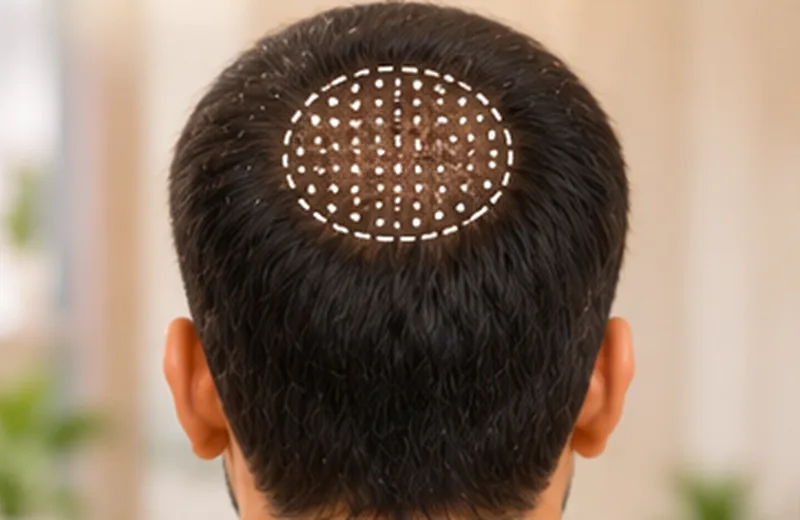
What is GFC hair treatment?
In PRP the platelets themselves are injected and release growth factors inside the scalp. In GFC the platelets are activated in the tube first. The growth factors are released into the fluid, and that fluid, without the cells, is injected.
The aim is the same: to deliver growth factors to weakened hair follicles. GFC is prepared in a standard kit, so each dose is prepared in the same way.
Who is it suitable for?
It is considered for early to moderate pattern hair loss in men and women, for diffuse thinning and as support after a transplant. Follicles must still be alive; it does not grow hair on bare, shiny scalp.
People with blood disorders, low platelets, active scalp infection or on blood thinners are assessed before it is offered.
How is a session performed?
- A blood sample is drawn into the GFC kit.
- The kit is processed to activate the platelets and separate the fluid.
- The scalp is cleaned and numbed.
- The concentrate is injected across the thinning area with a fine needle.
The visit takes about an hour. Three to four sessions a month apart are usual, with maintenance if there is a response.
How does GFC compare with PRP?
Both come from your own blood and are given in the same way. GFC has no red or white cells in the injected fluid, which some people find gives less soreness afterwards. Research on GFC is newer and smaller than research on PRP, so it is not described as stronger. The choice is discussed for your case on the PRP hair treatment page and at consultation.
What are the risks and limits?
Mild soreness, redness or swelling for a day are common. Headache and infection are uncommon. Temporary shedding can occur. Response varies, and some people see little change.
It does not replace treatment for the cause of hair loss; see hair-loss treatment.
What affects the cost in Surat?
The kit used, the number of sessions and maintenance needs decide the total. GFC kits usually cost more per session than standard PRP preparation.
See PRP sessions for hair loss for how a course is planned and judged.
Independent patient information: NHS: hair loss and American Academy of Dermatology: hair loss.
Common questions
GFC Hair Treatment in Surat, answered.
Short, honest answers. Your own case is discussed at consultation. All questions.
What does GFC stand for?
GFC stands for growth factor concentrate. It is a clear fluid, rich in growth factors released from your own platelets, prepared from a small blood sample in a closed kit. It is injected into the thinning scalp in the same way as PRP and is used as a supportive treatment.
Is GFC better than PRP for hair?
It is not proven to be better. The two are related, and research on GFC is more limited. The choice depends on your case and is discussed at consultation, where the cause of your hair loss, your medical history and your expectations are considered before either treatment is suggested.
How many GFC sessions are needed?
Three to four sessions, about a month apart, are usual to begin with. Photographs are taken before the first session and repeated at three and six months. Maintenance sessions are considered only if those photographs show a response, so that treatment is not continued without benefit.
Is GFC treatment safe?
It uses your own blood, so allergy is unlikely, and soreness and mild swelling for a day are the usual effects. Your medical history is checked beforehand, so tell the team about any blood disorder, infection or medicine you take. Report anything unusual after a session to the clinic by phone or WhatsApp.
Can GFC be done after a hair transplant?
It is sometimes used as support after a transplant, with the aim of helping the grafts and the surrounding native hair. The timing is decided by the surgeon, usually once the grafts have settled in the first weeks. It is optional and is discussed as part of your aftercare plan.
Consultation with Dr. Ashutosh Shah at the Vesu clinic, by appointment. No forms, no waiting on hold.