
Hair Transplant in Surat
Male Hair Transplant in Surat
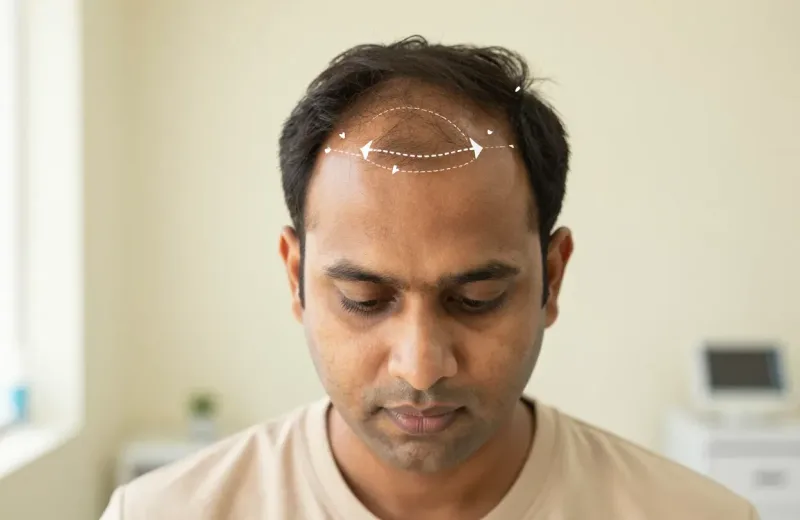
Male hair transplant in Surat moves lasting hair from the back and sides of the head to a receding hairline, a thin mid-scalp or the crown. It is for men with male-pattern hair loss whose pattern can be assessed and whose donor area is healthy. Because the loss continues with age, the plan covers a lifetime, not one session.
Who is a candidate for a male hair transplant?
In male-pattern hair loss the hair at the temples, front and crown thins over the years, while the hair at the back and sides is far more resistant. Suitability depends on the stage of the pattern, age, donor strength and expectations.
- Early stages. Slight recession at the temples is often managed with medical treatment alone, and surgery is kept in reserve.
- Middle stages. A receded hairline, a thin front or a visible crown with a good donor area is the most common reason for surgery.
- Advanced stages. Surgery is possible when the donor supply is good, but priorities are set, usually the front and mid-scalp first.
Men in their early twenties are assessed with extra care, because the final pattern cannot yet be seen. Many are advised to stabilise the loss with treatment and be reviewed later.
How are the donor area and the hairline planned for a lifetime?
Donor hair is limited and does not grow back once it is moved, while male-pattern hair loss keeps progressing around the transplanted hair. A plan that spends most of the donor supply on a low, dense hairline in a young man can leave too little for the mid-scalp and crown later. So donor density is measured, a lifetime graft budget is estimated and part of it is kept in reserve.
The hairline is designed to suit the age. A mature hairline sits a little higher than a teenage one, with slight recession at the temples, so it looks natural now and still fits the face decades later. It is drawn with you before surgery, with an irregular front edge of single hairs and denser grafts behind.
Which method suits men, FUE or FUT?
- FUE removes follicular units one by one and leaves small dot marks. It suits men who keep their hair short and most small to moderate plans. See the FUE page.
- FUT removes a narrow strip and leaves a line that longer hair covers. It can supply many grafts in one session. See the FUT page.
The grafts grow in the same way with either method. The choice depends on graft need, scalp looseness and hairstyle, and in advanced loss both may be used in stages.
Why is medical treatment advised alongside surgery?
A transplant does not stop male-pattern hair loss. The native hair around the grafts can go on thinning, which over time leaves gaps behind a transplanted hairline. Medicines such as minoxidil and finasteride slow this loss in many men, so they are usually discussed before surgery and continued after it where they suit you.
They are prescribed after a discussion of benefits and possible side effects, and the decision is yours. The page on male-pattern hair loss explains the options.
What is the recovery timeline for men?
- Days 1 to 3: mild swelling of the forehead and a tight feeling; rest and sleep with the head raised.
- Days 7 to 10: crusts are washed away gently. Desk work is usually possible after five to seven days.
- Weeks 2 to 6: the transplanted hairs shed while the roots rest. This is expected.
- Months 3 to 4: new growth starts, fine at first.
- Months 9 to 12: the result is judged. The crown can take longer.
Gym work, swimming and helmets are restarted as advised. The recovery timeline covers each stage.
What are the risks and limits?
Possible effects include swelling, temporary numbness, small pimples around growing hairs, shedding of nearby native hair, infection and poor growth of some grafts. FUE leaves dot marks and FUT leaves a line, so neither method is free of marks. Taking too many grafts can thin the donor area.
A transplant moves hair; it does not create new hair. In advanced loss the donor supply cannot match the hair that has been lost, so the crown may stay lighter. More than one session may be needed over the years, and no percentage of growth is promised.
What decides the cost of a male hair transplant in Surat?
The main factors are the number of grafts, the method or combination of methods, whether one session or more are planned, the use of beard grafts and the aftercare included. Corrective work on an earlier transplant is assessed separately.
A written estimate is given after the scalp and donor area have been examined at Elegance Clinic in Vesu or Adajan. Appointments are booked by WhatsApp or phone. The cost guide lists what to ask any clinic.
Independent patient information: NHS: hair transplant and International Society of Hair Restoration Surgery: treatments for hair loss.

Common questions
Male Hair Transplant in Surat, answered.
Short, honest answers. Your own case is discussed at consultation. All questions.
At what age should a man consider a hair transplant?
There is no fixed age, but most surgeons prefer to wait until the pattern of loss can be read, which is often in the late twenties or later. Younger men are usually advised to stabilise the loss with medical treatment first, because an early transplant can look unnatural as the surrounding hair recedes.
Will a man keep losing hair after a transplant?
The transplanted hair usually lasts, because it comes from the resistant zone at the back of the head. The native hair around it can continue to thin with age. This is why medical treatment is often continued and why part of the donor supply is kept for a later session.
Can a man with advanced hair loss get full coverage?
Often not in full. The donor area holds a limited number of grafts, and a large bare area can need more than it can safely give. The usual plan restores the hairline and front, adds moderate density to the mid-scalp and treats the crown lightly or in a later session.
Do men have to take finasteride after a hair transplant?
No, it is a choice, not a condition of surgery. It is often recommended because it slows the loss of native hair around the grafts in many men. The surgeon explains the expected benefit and the possible side effects, and other options are discussed if you prefer not to take it.
How low can a hairline be placed in a man?
Low enough to frame the face, but not at its teenage position. A mature hairline with slight temple recession looks natural as you age and uses fewer grafts. The surgeon draws it with you before surgery, and it is adjusted until both of you are satisfied with the shape.
Consultation with Dr. Ashutosh Shah at the Vesu clinic, by appointment. No forms, no waiting on hold.