
Scalp Micropigmentation in Surat
Density Scalp Micropigmentation in Surat
Density scalp micropigmentation in Surat places pigment dots between existing hairs so that less scalp shows through thinning hair. It is used on a widening parting, a thin crown or between transplanted hairs. It adds no hair and works only where there is still hair to cover the dots.
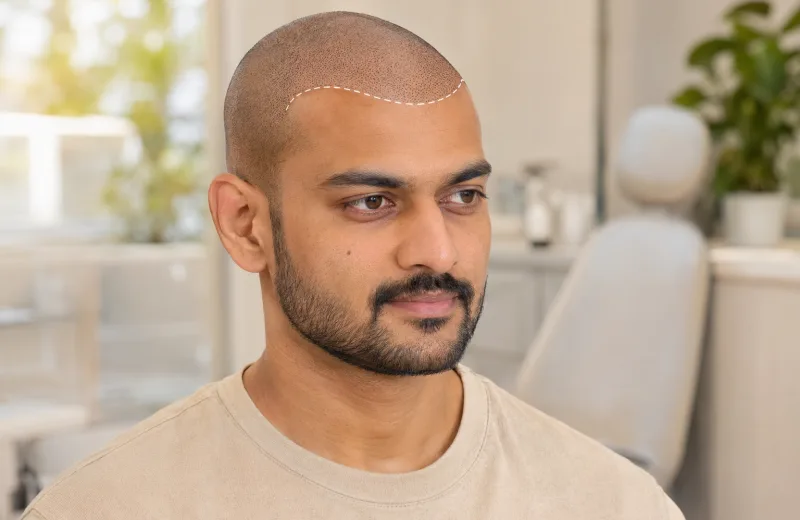
What is density scalp micropigmentation?
Thin hair looks thinner when pale scalp shows between the strands. Density SMP darkens the scalp with tiny dots in a shade close to the hair root. The contrast drops, and the same hair looks fuller.
The dots are placed more lightly and more sparsely than in a shaved-head treatment, because hair will lie over them.
Who is it suitable for?
It suits women with a widening parting, men and women with diffuse thinning, and people who want more visual density after a transplant. Dark hair on lighter scalp shows the greatest change.
It does not suit areas with no hair at all unless the head is kept shaved; see shaved-head scalp micropigmentation. Active hair loss is treated medically as well.
How is it done?
- The thin areas are mapped with the hair parted in rows.
- Pigment is matched to the root colour.
- Dots are placed between hairs along each parting line.
- Two to three sessions, one to two weeks apart, build the effect gradually.
Hair does not need to be shaved.
What is care afterwards?
The scalp is kept dry for three to four days. Hair colour, harsh shampoo, swimming and heavy sweating are avoided for about a week. Mild redness settles quickly, and the dots soften in shade as the skin heals.
What are the risks and limits?
Possible problems are fading, blurring of dots, colour change over time, infection and rare allergy. If hair loss continues, the dots can become visible in areas that have gone bare, so ongoing hair-loss treatment is usually advised.
If you go grey later, the pigment tone may need adjusting.
What affects the cost in Surat?
The size of the area, the number of sessions and future touch-ups decide the total. A parting needs less work than the whole top of the scalp.
The main scalp micropigmentation page explains the technique and its other uses.
Independent patient information: NHS: hair loss and American Academy of Dermatology: hair loss.
Explore
Related treatments
Scalp Micropigmentation
The main page: who it suits, how it is done, recovery, risks and cost factors.
View details →02Shaved-Head Scalp Micropigmentation
Shaved-head scalp micropigmentation in Surat places thousands of tiny pigment dots in the scalp to give the look of a closely shaved full head of hair.
View details →Common questions
Density Scalp Micropigmentation in Surat, answered.
Short, honest answers. Your own case is discussed at consultation. All questions.
Does density micropigmentation need my head shaved?
No. The hair is parted in rows and the pigment dots are placed between the hairs along each parting. Your hairstyle and length stay the same. The treated area is kept dry for three to four days, and after that you can wash and style as usual.
Is density micropigmentation suitable for women?
Yes. It is often used for a widening parting or diffuse thinning in women, where there is hair over the whole scalp but the scalp shows through. The cause of the thinning should be assessed first, because pigment reduces the contrast but does not treat the hair loss itself.
Will the dots show if my hair thins more?
They can, in an area that becomes completely bare, because pigment has no texture. This is why the dots are placed lightly and in a soft shade, and why treatment for the hair loss itself is usually continued. A touch-up can adjust the look if your hair changes.
Can it be combined with a hair transplant?
Yes. Pigment can add visual density between transplanted hairs, or tone down a pale donor scar. It is usually done after the transplant has fully grown, at about twelve months, so that the dots are placed around the final hair. The two are planned together where possible.
Can I colour my hair after micropigmentation?
Yes, once the scalp has healed, which usually takes about two weeks. Tell your stylist about the treatment so that strong bleach is kept off the scalp, because harsh chemicals can lighten the pigment. Gentle, ammonia-free colour applied to the hair lengths is the safer choice.
Consultation with Dr. Ashutosh Shah at the Vesu clinic, by appointment. No forms, no waiting on hold.